
Howo 2009: The Pivot Year That Reshaped Global Truck Engineering
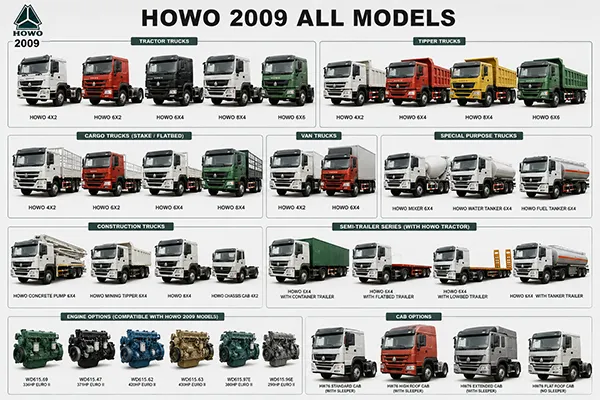
The year 2009 stands as a monumental milestone for the heavy-duty vehicle industry. For SINOTRUK, it was the moment when Howo 2009 advanced engineering merged with future‑ready technology, giving birth to the legendary HOWO‑A7 series. Built with intelligent AMT systems, high‑torque D12 engines and lightweight chassis breakthroughs, the Howo 2009 generation delivered a perfect blend of durability and operational economy. Fleets and owner‑operators who rely on genuine howo parts know that this lineage remains the backbone of reliable logistics, from African mining corridors to South American long‑haul routes.
SmartShift-AMT
WABCO modular AMT, fuel saving up to 3%
Giugiaro cab
Low air drag & four‑point suspension
D12 engine
380–420 hp / 1820 Nm peak torque
Lightweight
High‑strength steel frame, -450 kg
Why Howo 2009 Became a Global Heavy‑Duty Icon
When SINOTRUK launched the HOWO‑A7 in late 2008 and accelerated its mass deployment in 2009, the commercial vehicle world took notice. The Howo 2009 chassis was engineered with 700 MPa high‑tensile steel, boosting payload without sacrificing rigidity. Alongside the frame, approach angles were increased by 3 degrees, improving off‑road capability for mining and construction sites. But the true revolution lived under the hood: the D12 engine family delivered 380 to 420 hp while maintaining low‑end torque from 1100 rpm, dramatically reducing downshifting on gradients.
Meanwhile, the 6×4 and 6×6 configurations made Howo 2009 ready for extreme environments, from Siberian frost to African deserts. Combined with self‑developed single‑reduction axles and optional differential locks, the vehicle quickly turned into the preferred tool for project cargo and heavy logistics, proving that Chinese heavy truck engineering had reached a new competitive level.
Powering the Revolution: Engine & Transmission in Howo 2009
| Engine options | D10.34 (249 kW), D12.38 (279 kW), D12.42 (309 kW) |
|---|---|
| Peak torque | 1650–1820 Nm @ 1100–1500 rpm (D12 engine line) |
| Transmission | HW19710 (10‑speed), optional HW19710T synchronised |
| AMT (SmartShift) | WABCO modular AMT, economy/power modes, 16‑speed logic |
| Emissions tech | Common‑rail & EGR (Euro III ready, Euro V upgradeable) |
The Howo 2009 powertrain lineup offered two distinct approaches: high‑pressure common rail for precise injection and ultra‑clean combustion, or the in‑house EGR solution that cut ownership costs by nearly $2000 per unit while sharing 70% parts commonality with existing fleets. This dual‑path strategy allowed SINOTRUK to serve both mature markets and price‑sensitive regions without sacrificing reliability. Coupled with the HW series gearbox (double countershaft + planetary auxiliary), the drivetrain excelled under full‑load start‑stop cycles. The optional SmartShift-AMT—co‑developed with WABCO—further reduced driver fatigue and improved fuel efficiency by 3% to 5% compared to manual shifting, making long‑distance hauling more economical than ever before.
Chassis, Safety & Driver‑First Cab Design
Driver safety and comfort were at the forefront of the Howo 2009 cab, co‑styled by Italdesign Giugiaro. The high‑roof layout integrated a fully digital VDO instrument cluster with CAN bus control, double sleeper berths and an ergonomic air‑suspended driver’s seat. Passive safety features included four‑point cab suspension with transverse stabilizers, energy‑absorbing steering column and double‑locking safety belts. The chassis used front disc brakes (on selected axles) and dual‑circuit air brakes with ABS, while EVB engine braking delivered controlled descents on steep grades.
Meanwhile, the modular electrical architecture simplified diagnostics and allowed telematics integration. For owners, this meant fewer roadside breakdowns and rapid part interchangeability – a huge advantage when operating across borders. The entire Howo 2009 range was engineered to meet rigorous international safety benchmarks (ECE), giving fleet managers peace of mind even on the most demanding routes.
Real‑World Impact: Where Howo 2009 Excels Today
Thousands of Howo 2009 units remain in active service across more than 90 countries, a testament to SINOTRUK’s durable design philosophy. In West Africa, Howo A7 tipper trucks move mineral ore under extreme dust loads; on Pan‑American highways, 6×4 tractors pull double trailers with outstanding fuel economy. The robustness of the HOWO platform has also made it a backbone for humanitarian logistics, military supply chains and megaproject construction. Because SINOTRUK still produces Howo 2009‑compatible service kits, fleet operators can rely on genuine howo parts to maintain original equipment performance and extend vehicle lifecycle beyond 15 years.
Logistics fleets
30‑33 L/100km average consumption
Mining & construction
6×6 all‑wheel drive variants, HC16 drive axle
Exports to 90+ nations
Euro V compliant versions sold in Brazil, Russia, SEA
LNG capability later
Natural gas variants succeeded Howo 2009 architecture
Legacy matters. The Howo 2009 generation wasn’t just a product refresh – it was the moment when SINOTRUK fused global sourcing (ZF steering, WABCO pneumatics, MAN powertrain DNA) with internal innovation, creating a truck that defined the “best value” segment for nearly a decade. Whether you are a fleet manager seeking durable second‑hand assets or a dealer looking for trusted pre‑2009 heavy equipment, understanding HOWO‑A7’s engineering DNA ensures you invest in proven reliability. For service support and genuine Howo 2009 wear parts, howo parts availability remains a priority, guaranteeing these legendary trucks keep rolling for years to come.
