
HOWO 2007: How a Chinese Heavy Truck Redefined Global Standards
HOWO 2007 marks a monumental year in the timeline of Sinotruk. The heavy-duty vehicle industry witnessed an unprecedented surge when the HOWO series not only dominated domestic sales but also stormed into international markets. For operators and fleet owners seeking authentic components, Howo parts remain the backbone of durability even today.
By 2007, Sinotruk had already emerged from restructuring years earlier, transforming into a powerhouse that would soon lead China’s commercial vehicle sector. The HOWO range—initially launched in late 2004—was still young, yet its engineering excellence captured both army logistics and heavy-haul private carriers. With a production capacity climbing to 60,000 units annually, 2007 became the year that accelerated HOWO from a local success into a global phenomenon.
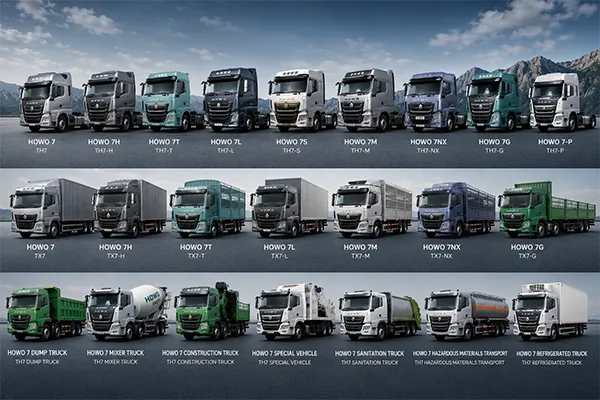
HOWO 2007 Production Milestone: Breaking the 60,000 Barrier
At the heart of the HOWO 2007 legend lies an extraordinary manufacturing feat. In March 2007, Sinotruk achieved its first-ever monthly production and sales volume exceeding 10,000 heavy trucks — an industry first in China. By the end of that year, total HOWO series sales surpassed 60,000 units, representing nearly 75% of Sinotruk’s total heavy-truck output.
Comparatively, Sinotruk sold merely 3,800 vehicles in 2000. Over seven years, the company’s market share skyrocketed from 4% to nearly 20%, making it one of the fastest-growing heavy-truck manufacturers worldwide. How did HOWO achieve such rapid acceptance? The secret lay in its extreme adaptability: the cab design incorporated Volvo-derived safety technology, while the chassis and driveline retained Steyr’s battle-tested reliability.
Fleet operators reported lower total cost of ownership and better fuel economy compared to previous domestic models. By 2007, order books were overflowing, and Sinotruk’s Jinan plants operated around the clock. The sheer demand reflected how operators trusted HOWO for maximum uptime and dependable after-sales support.
The International Leap: HOWO Conquers Russia & Beyond
For HOWO 2007, the world was no longer a distant prospect. Early that year, Sinotruk formally entered the Russian heavy-truck market. By May 2007, 50 HOWO models had received full Russian vehicle certification, and more than 30 service stations were established across the country. Russian customs data confirmed robust acceptance of Chinese heavy trucks.
According to Chinese customs data, over 4,000 HOWO trucks were sold to Russia in 2007 alone. And within the first five months of 2007, HOWO ranked third among all foreign heavy-truck brands sold locally, behind only Volvo and Scania. The rapid growth signaled that HOWO had broken through traditional European dominance in Eastern Europe.
In December 2007, Sinotruk signed a landmark agreement with Russia’s ZIL automobile corporation to establish HOWO-ZLL, a 50/50 joint venture for assembling and selling HOWO trucks in Russia. This marked the first heavy-truck joint venture between a Chinese truck maker and a Russian partner. Immediately following the agreement, a 7,600-unit sales contract was signed for 2008, including an initial order of 800 trucks for January alone.
Meanwhile, Sinotruk also struck a 2,500-truck export deal with Vietnam’s TMT Auto, pushing total 2008 international orders beyond 10,000 vehicles. The year thus transformed HOWO into a true global brand, setting the stage for decades of export leadership. Export success further fueled the expansion of HOWO’s overseas service network.
Serving the Nation: HOWO 2007 Fully Adopted by PLA Garrison Forces
Another seldom-told chapter of HOWO 2007 is its strategic military role. HOWO military trucks first entered active service in 2005, but 2007 marked the complete switchover: the HOWO series officially replaced the older Steyr-based military trucks as the exclusive vehicle for the People’s Liberation Army (PLA) garrison in Hong Kong. That year, the first batch of HOWO 4×2 military cargo trucks was delivered to the Hong Kong garrison, followed soon by 6×4 variants.
These robust vehicles were deployed in critical missions, including advance reconnaissance, mechanized drills, routine logistics and cross‑border operations. The military’s endorsement cemented HOWO’s reputation for extreme reliability under the harshest conditions — from tropical humidity to rugged mountain terrain. Military-grade HOWO variants shared the same core drivetrain as civilian models, proving battlefield durability.
- Engine options (2007) – WD615.69 (336 HP) / WD615.47 (371 HP) / D12.42-20 (420 HP) Euro II–III
- Gearbox – 9, 10 or 12-speed manual transmission
- Displacement – 9.7L inline-6, turbocharged & intercooled
- Axle configuration – 4×2, 6×4, 8×4 (most popular: 6×4 tractor)
HOWO 7 Series Classification (2007): Core Variants That Dominated Global Haulage
The HOWO 7 series in 2007 was not a single model but an entire family of heavy-duty trucks engineered for specific vocational needs. Based on the versatile HOWO platform, Sinotruk offered more than 15 base configurations, with five core categories leading global sales. Below are the main classifications that made HOWO a legend across construction, logistics, energy and military sectors.
Tractor (6×4 / 4×2)
Long-haul king – 6×4 tractors with 336–420 HP, FAST 9/12 speed gearbox, 400L fuel tank, designed for container, flatbed and bulk transport. Over 38,000 units sold in 2007 alone.
Best-sellerDump Truck (8×4 / 6×4)
Heavy-duty tipper for mining and construction. Reinforced frame, 16-ton planetary axles, high-capacity hydraulic system. Popular in infrastructure projects across Asia and Africa.
Rugged performerCargo / Flatbed Truck
Versatile 4×2 and 6×4 rigid chassis with customizable cargo body lengths (5.6m–8.5m). Used for general freight, agricultural products and intra-city distribution.
FlexibleConcrete Mixer Truck
8×4 chassis modified for 8–12 cubic meter mixer drums. Equipped with PTO-driven hydraulic system, heavy-duty suspension and reinforced rear axles. Cornerstone of urban construction fleets.
Construction iconTanker Truck
Specialized chassis for fuel, water or chemical transportation. Anti-static design, corrosion-resistant piping and optional heating systems. Widely exported to Middle East and CIS markets.
SpecializedMilitary Tactical Truck
4×4 / 6×6 military-grade variants adopted by PLA Hong Kong garrison. Reinforced electronics, blackout lighting, multi-fuel engine compatibility and central tire inflation system (optional).
National defenseComplete Technical Specifications (HOWO 2007)
Technological Excellence: 100+ Patents & Automotive Science Award
Behind every robust HOWO 2007 frame was deep engineering innovation. By mid‑2007, the HOWO series had accumulated over 100 independent patents, covering everything from cab safety structures and engine combustion control to intelligent electronic architectures. In recognition of this excellence, the “HOWO‑brand Series Heavy Vehicles” project won the second prize of the China Automotive Industry Science and Technology Award — the only national‑level automotive science award approved by the Ministry of Science and Technology.
The industry began calling HOWO the “Heavy Truck Leader”, a title that reflected not only sales dominance but also genuine technological advancement. Meanwhile, Sinotruk’s Jinan Power Co. invested nearly one billion CNY to raise its engine production capacity to 60,000 units per year, introducing 10‑liter high‑pressure common‑rail engines that would become the gold standard for emerging markets. This investment laid the foundation for Sinotruk’s next-generation powertrains.
HOWO 2007 in Numbers: A Quick Spec Snapshot
Standard HOWO 2007 tractors (6×4) delivered between 266 to 420 horsepower depending on the engine variant. Most popular was the WD615.69 generating 336 HP @ 2200 rpm, paired with a 9‑speed gearbox and 16+16 ton rear axles. The cabin featured a 2.5‑meter internal width — the widest in its class in China at that time — and met rigorous Swedish cab safety standards.
Auxiliary systems included four‑point air suspension, integral power steering, and an optional engine brake for downhill control. Thanks to these versatile specs, HOWO quickly became the default choice for long‑haul logistics, construction hauling, and even specialized tanker applications. The modular design also simplified maintenance for overseas fleets.
Why HOWO 2007 Still Matters Today
Many of the industry standards established in 2007 continue to influence Sinotruk’s current lineup. The HOWO 7 series platform set the foundation for later generations — HOWO‑A7 (2009), HOWO‑T7 (2013), and even modern autonomous HOWO models. Moreover, the global service networks built in 2007 laid the groundwork for Sinotruk’s aftermarket dominance.
Authentic Howo parts remain widely available across Africa, the Middle East, and Latin America. For collectors, operators, and historians, HOWO 2007 is not just a year — it is the pinnacle of Chinese heavy‑truck industrialization. The legacy continues to shape global freight and defense logistics.
Over the past decade, the legacy of HOWO 2007 has expanded well beyond vehicle sales — it created an entire ecosystem of genuine components. As of 2026, Sinotruk continues to manufacture spare parts compatible with 2007‑era HOWO trucks, from cabin assemblies to full gearbox rebuild kits. This commitment to long‑term support is rare among heavy‑truck manufacturers and has made HOWO a favorite in emerging economies where fleets often run vehicles for 15 to 20 years.
Fleet managers in Zambia, Nigeria, and Peru routinely rely on HOWO 2007 series trucks because of the ease of service and the continued availability of certified Howo parts. The international parts supply chain that began taking shape in 2007 now spans over 100 countries, generating hundreds of millions in annual turnover. Even after two decades, HOWO remains a synonym for durability and value retention.
