
Complete Sinotruk Fault Codes Database for Howo Trucks
Every heavy-duty truck operator knows that engine diagnostics are the key to preventing costly breakdowns. Whether you are a fleet manager, mechanic, or owner-operator, understanding how to read and interpret diagnostic trouble codes is essential. For reliable repairs and replacement components, we highly recommend sourcing your components from Howo parts to maintain genuine performance standards. This comprehensive resource covers thousands of Sinotruk fault codes, including standard OBD-II codes, flash codes, SAE J1939 SPN-FMI codes, and practical troubleshooting techniques specifically tailored for Howo trucks. Sinotruk fault codes are the first step in accurate vehicle diagnosis.
Modern Howo trucks are equipped with advanced ECU systems, and when a problem occurs, the onboard computer generates a specific trouble code. This guide will walk you through the most common Sinotruk fault codes, their system classifications, professional diagnostic tool usage, and systematic repair approaches. By mastering these codes, you can reduce downtime and extend the service life of your vehicle.
DTC Library
Complete Sinotruk fault codes with flash codes and descriptions
SPN-FMI Codes
SAE J1939 standard codes for advanced diagnostics
Diagnostic Tools
EOL OBD scanners and professional calibration tools
Repair Guides
Step-by-step troubleshooting for Howo trucks
Sinotruk Fault Codes: Complete DTC List and System Breakdown
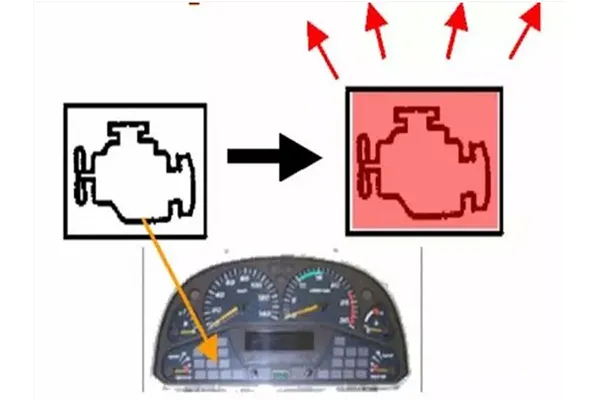
The diagnostic trouble code system used by Sinotruk Howo trucks follows internationally recognized standards. Each Sinotruk fault code consists of a letter prefix followed by a four-digit number, where “P” indicates powertrain codes, “U” indicates network communication codes, “C” indicates chassis codes, and “B” indicates body codes. Additionally, each fault corresponds to a flash code visible on the dashboard instrument cluster, making rapid diagnosis possible without a scanner in emergency situations.
Common Sinotruk Fault Codes – DTC Table
| DTC Code | Fault Description | Flash Code | Related System |
|---|---|---|---|
| P0122 | Acceleration Pedal 1 – Signal Too Low | 22 | Engine/Throttle |
| P0123 | Acceleration Pedal 1 – Signal Too High | 22 | Engine/Throttle |
| P0222 | Acceleration Pedal 2 – Signal Too Low | 22 | Engine/Throttle |
| P0193 | Common Rail Pressure Sensor – Signal Too High | 67 | Fuel System |
| P0192 | Common Rail Pressure Sensor – Signal Too Low | 67 | Fuel System |
| P0563 | Vehicle Voltage – Voltage Too High | 26 | Electrical System |
| P0562 | Vehicle Voltage – Voltage Too Low | 26 | Electrical System |
| P0118 | Coolant Temperature Sensor – Signal Too High | 11 | Cooling System |
| P0117 | Coolant Temperature Sensor – Signal Too Low | 11 | Cooling System |
| P0337 | NE Sensor – No Pulse Signal | 13 | Engine/Crank Position |
| P0502 | Vehicle Speed Sensor – Open/Short Circuit | 21 | Chassis/Speedometer |
| P2148 | Injector COM1 – Short Circuit to Battery | 57 | Fuel/Injector System |
| P1681 | Exhaust Brake Output – Open Circuit | 28 | Exhaust/Brake System |
| P0238 | Intake Air Pressure Sensor – Signal Too High | 37 | Air Intake System |
| P0237 | Intake Air Pressure Sensor – Signal Too Low | 37 | Air Intake System |
Complete Sinotruk fault codes database includes over 150 unique diagnostic codes covering all Howo powertrain and chassis systems.
How to Read Sinotruk Fault Codes: Professional Diagnostics
Interpreting Sinotruk fault codes requires understanding both the DTC structure and the underlying system behavior. Codes starting with “P0” represent generic OBD-II codes, while manufacturer-specific codes (P10xx through P19xx) provide deeper insight into Howo engine and transmission systems. The flash code numbers displayed on the dashboard offer a quick reference: for example, a flashing pattern of 2 long and 2 short flashes indicates code 22 (accelerator pedal signal issue), while 6 long and 7 short flashes indicates code 67 (common rail pressure sensor problem).
Sinotruk Fault Codes by System Category
Fuel System
Common rail pressure sensor faults (P0191-P0193), injector COM1/COM2 open/short circuits (P2146-P2151), TWV coil failures (P0201-P0205). Sinotruk fault codes for fuel delivery issues.
Cooling System
Coolant temperature sensor failure (P0117-P0118), fan control circuit faults, and thermostat malfunction codes requiring immediate attention.
Electrical System
Voltage monitoring codes (P0562-P0563), alternator regulation faults, battery management system warnings, and BBM body control module errors.
Exhaust & Aftertreatment
Exhaust brake output faults (P1681-P1682), SCR system DTCs for AdBlue dosing, NOx sensor errors, and DPF regeneration codes.
Professional Diagnostic Tools for Sinotruk Fault Code Analysis
Accurate reading and clearing of Sinotruk fault codes requires specialized diagnostic equipment. The EOL (End of Line) OBD diagnostic tool is the industry standard for Howo trucks, capable of communicating with all electronic control units including engine ECU, ABS, EBS, ECAS, AMT, retarder, CBCU, BCU, and SCR systems. This professional scanner supports fault code reading and clearing, real-time data monitoring, parameter configuration, active component testing, and P-file software flashing and upgrading.
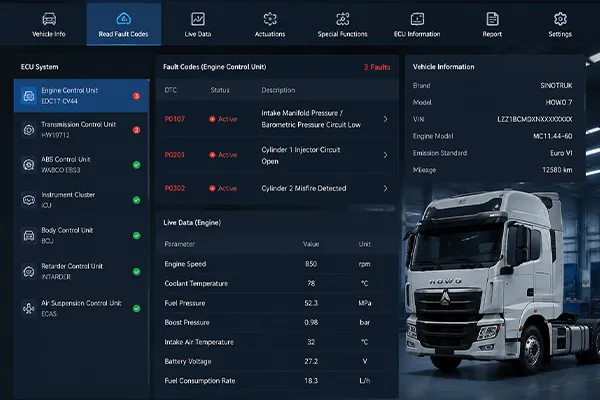
Recommended Diagnostic Equipment for Howo Trucks
- EOL OBD Diagnostic Scanner – Diagnoses all Sinotruk electronic controllers, including engines (Bosch, EControls), Denso ECU, ABS, EBS, AMT, SCR, CBCU, VCU, and camera systems. Supports active testing and P-file upgrades.
- Bluetooth OBD Adapter + Mobile App – Affordable smartphone-based solution (under $50) for reading basic Sinotruk fault codes and monitoring live sensor data via J1939 protocol.
- 6-in-1 EOL Calibration Tool – Specialized for Weichai and Sinotruk engines, offering ECU inspection for more than six control modules per truck including ABS ECU and AMT ECU.
All diagnostic tools mentioned above support SAE J1939-71 (DTC definitions), J1939-73 (diagnostic protocols), and CANBUS/CAN-FD communication standards for full compatibility with Howo trucks.
Troubleshooting Common Howo Truck Issues Using Fault Codes
When Sinotruk fault codes appear, systematic troubleshooting prevents misdiagnosis. Below are the most frequent failure scenarios encountered by Howo truck operators, each linked to specific DTC patterns that help pinpoint the root cause.
Engine Won’t Start
Common codes: P0562 (low voltage), P0337 (NE sensor), P0192 (fuel pressure low). Check battery terminals, starter relay, fuel filter, and crankshaft position sensor.
Loss of Power
Possible P0238 (intake pressure high), P0193 (rail pressure high), P2148 (injector short). Inspect air filter, fuel rail pressure regulator, and injector wiring harness.
Overheating
P0118 indicates coolant sensor failure. Verify coolant level, fan clutch operation, radiator blockage, and water pump condition regardless of sensor reading.
Excessive Exhaust Smoke
Black smoke points to injector faults (P0201-P0205) or boost leaks; white smoke indicates coolant intrusion or injector timing issues requiring professional inspection.
Professional Resource: Complete Sinotruk fault codes reference documentation is available in the official service manuals. The Howo WD615 Series Euro II Diesel Engine Operation Manual and D12 Euro III Repair Manual include comprehensive diagnostic flowcharts and wiring diagrams for all major fault code scenarios.
Manual Fault Code Clearing Procedure for Howo Trucks
In certain situations where a diagnostic scanner is unavailable, Sinotruk fault codes can be cleared manually through a specific pedal sequence. Note that this procedure should only be performed after confirming the underlying mechanical issue has been fully resolved, as clearing codes without repair will not prevent the fault from returning.
- Turn the ignition key to the ON position without starting the engine.
- Fully depress and release the accelerator pedal five times within five seconds.
- Press and hold the accelerator pedal completely for more than ten seconds until the malfunction indicator lamp begins flashing.
- Release the accelerator pedal completely and turn the ignition back to the OFF position.
- Restart the engine and confirm that the fault light has been extinguished.
